Ground anchor testing
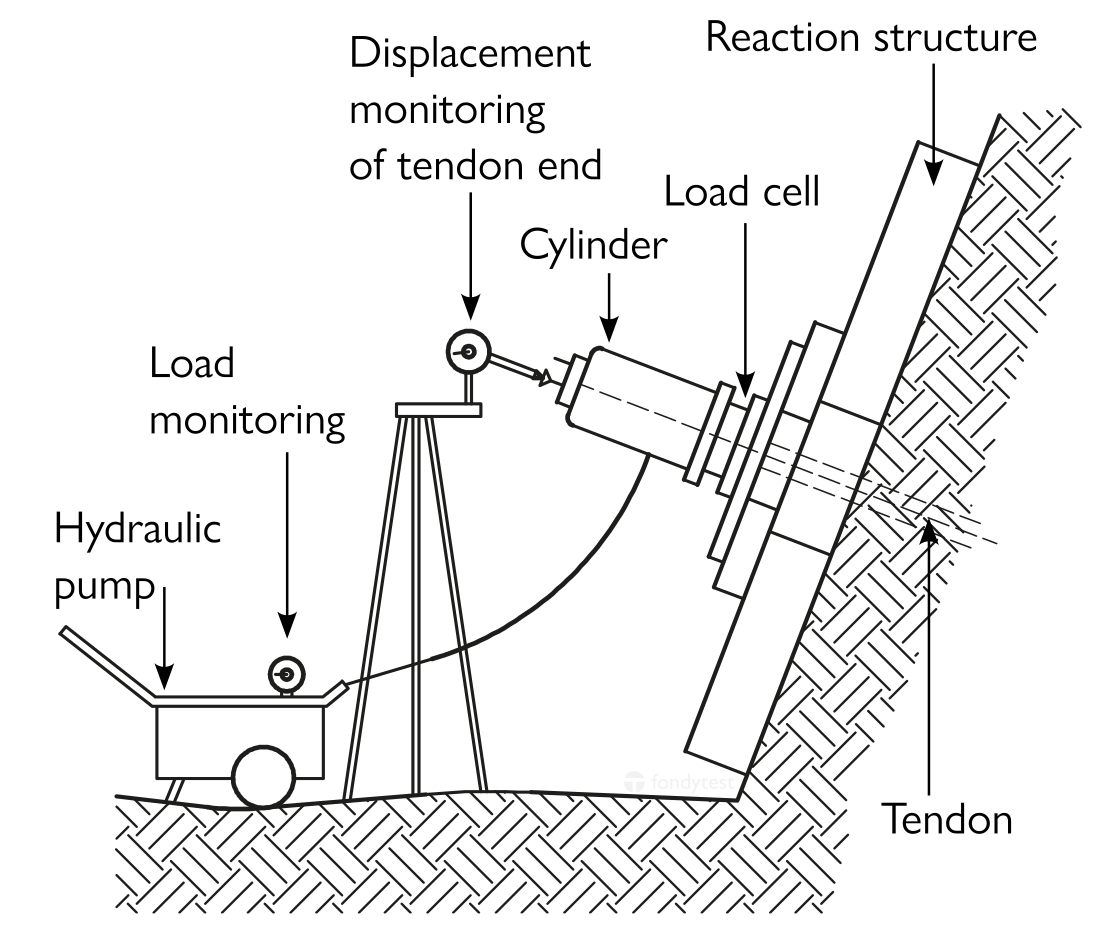
A static load test on a grouted anchor is performed by applying a controlled tensile load to the anchor head and measuring the resulting displacement. Such a test can:
- Verify that the anchor achieves the required load-bearing capacity;
- Assess the creep behaviour of the anchor under sustained load;
- Confirm the suitability of the anchor design and installation method for the given ground conditions.
We perform three types of anchor tests in accordance with ISO 22477-5 (2018): the investigation test, the suitability test, and the acceptance test. These are described below.
Test types
According to ISO 22477-5 (2018), there are three test types:
- Investigation test
- A test performed on trial anchors before construction begins. Its purpose is to study the behaviour of the ground-anchor system and determine or refine design parameters.
- Suitability test
- A test carried out on selected working anchors during the early stage of the project. It verifies that the anchor design and installation method are appropriate for the ground conditions and can safely sustain the required loads.
- Acceptance test
- A routine test performed on each installed working anchor (or a defined proportion of them). It confirms that the anchor has been installed correctly and can safely carry the specified service load before being put into use.
Results
A static load test on a grouted anchor can:
Verify the anchor's load-bearing capacity
- The test directly measures the anchor's response to loading, confirming that the required capacity is achieved in the actual ground conditions.
Assess creep behaviour under sustained load
- By holding the load at defined levels for specified durations, the test measures creep displacement and allows comparison against the acceptance criteria of EN 1537 (Figure 1).
Validate the design and installation method
- Investigation and suitability tests provide confidence that the anchor design and grouting procedure are appropriate before production installation begins.
Distinguish elastic and plastic displacements
- By unloading the anchor in steps, the test separates the recoverable (elastic) displacement from the permanent (plastic) displacement, giving insight into anchor behaviour (Figure 2).
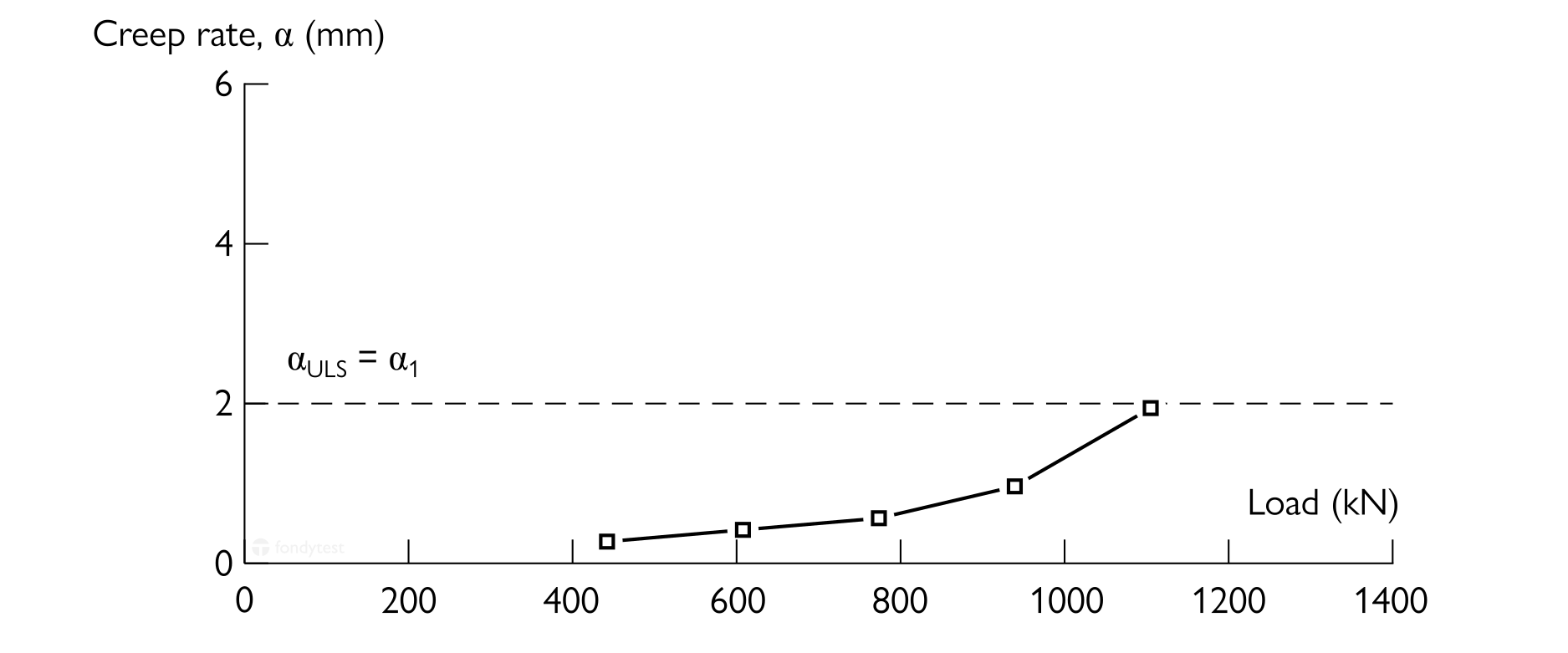
Figure 1 Measured creep
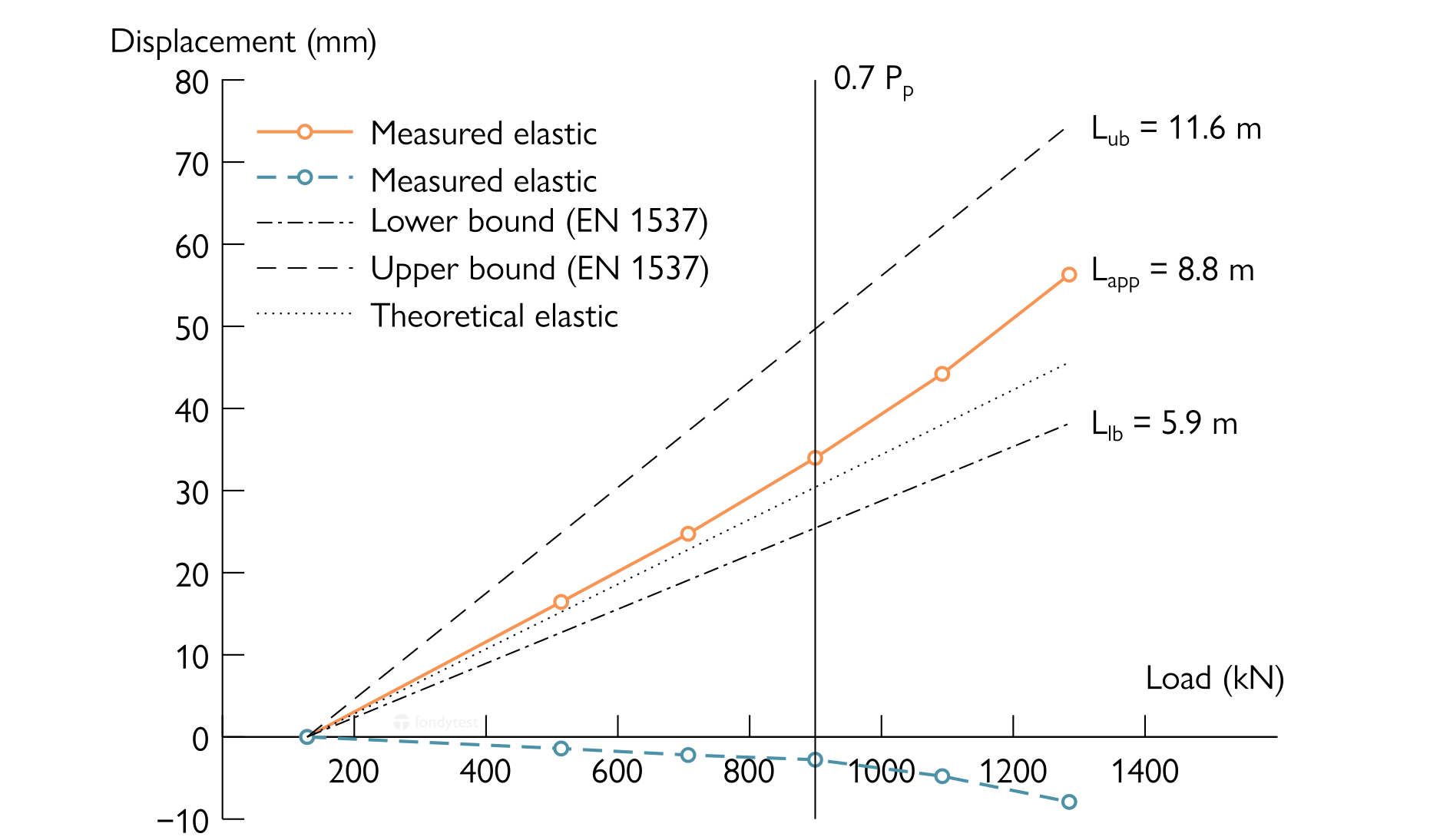
Figure 2 Measured elastic and plastic displacements
Built for accuracy, ready for demanding sites
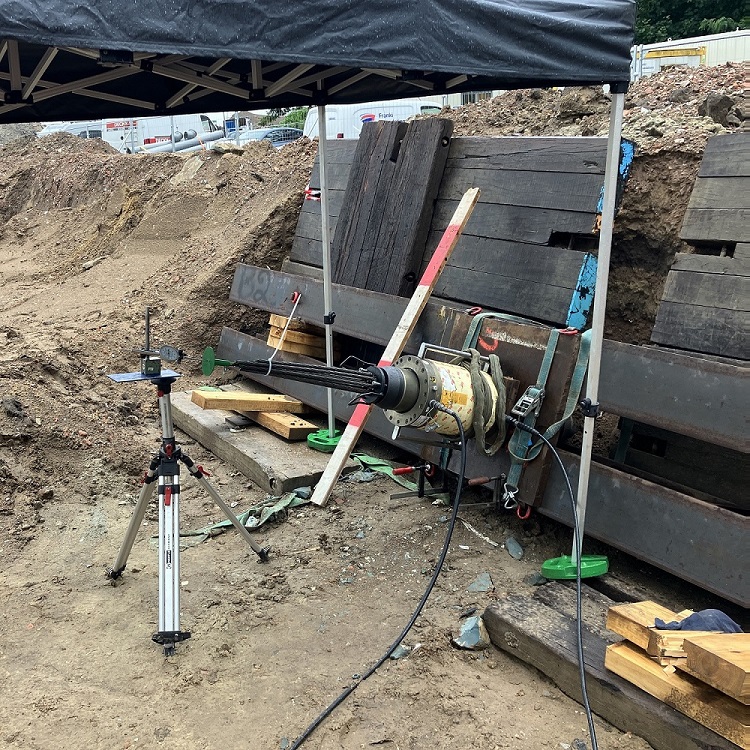
Our team has the ability, experience and resources to tackle a wide range of configurations.
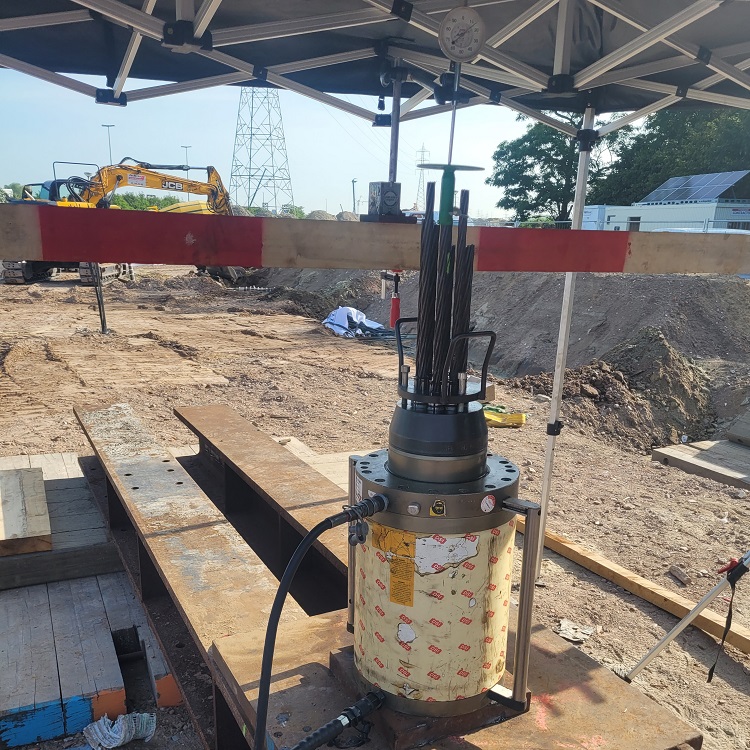
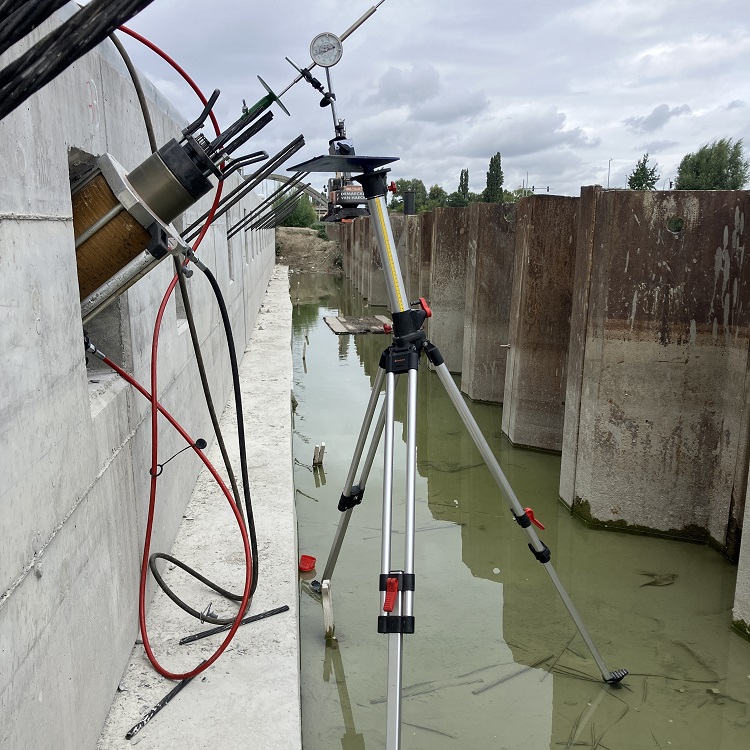
Our testing rigs are purpose-built for ground anchor work - from routine acceptance tests to high-load investigation campaigns. For most projects, we use a hollow-centre hydraulic jack with a capacity of 140, 180, or 270 ton (1400, 1800, or 2700 kN) and a 250 mm stroke. For large-scale or special projects, we can mobilise a 500 ton jack with a 350 mm stroke.
Load is measured by a calibrated hydraulic pressure gauge; a calibrated load cell can be added for projects requiring dual measurement. Anchor head displacement is tracked thanks to a dial indicator down to a resolution of 0.01 mm, precise enough to capture the subtle creep movements that determine whether an anchor meets the acceptance criteria.
All instruments are independently calibrated every six months in accordance with the relevant standards.
For questions, remarks, or a quotation, please do get in touch with us.
Grouted ground anchor testing is also referred to as anchor pull-out testing, anchor proof testing, or anchor creep testing.
We are based in Belgium and also available in the neighbouring countries: the Netherlands, Luxembourg, and France.
We perform static load testing of grouted anchors following the ISO 22477-5 (2018) (alongside with EN 1537, 2013, DIN 4125, 1990) or NF P 94-153 (1993). Our tests also comply with EN 1997-1 (Eurocode 7) requirements for the verification of anchor resistance.


Frequently asked questions
-
What is a ground anchor?
A ground or grouted anchor is designed to transmit a tensile force to a load-bearing stratum. It consists of:
- The anchor head is the component that transmits the force from the tendon to the structure (retaining wall, slab, etc.)
- The tendon is the load-carrying part of the anchor; it is typically made of high-strength steel (bars or strands)
- The grout body is the hardened cementitious material that creates the bond between the tendon and the ground
-
What is the difference between an investigation test, a suitability test, and an acceptance test?
Investigation tests are performed on sacrificial anchors to determine ultimate capacity. Suitability tests are performed on non-working anchors to verify the design before production. Acceptance tests are performed on every production anchor (or a sample) to confirm each anchor meets the required performance before handover.
-
What is creep, and why is it important for anchor testing?
Creep is the continued displacement of an anchor under a constant applied load. EN 1537 specifies maximum creep rates at each load level. If an anchor exceeds these limits, it fails the acceptance criteria, indicating that the grout-ground interface may not be adequate for long-term performance.
-
Can you test existing (old) anchors?
Yes. Existing or older anchors can be tested to verify their current load level and condition.
Even anchors that were not originally designed for future testing can often still be checked. For that purpose, we use specialised equipment that can grip smooth headblocks with no protruding strands, allowing lift-off testing to be carried out and the anchor force to be measured.
These tests help confirm that anchors still provide the required support, and they can also reveal whether re-stressing or maintenance may be necessary.